
You must be logged in to post a review.
€68.00
Figure to assemble and paint
Ref.: 11 – NAP
Weight: 230 grs.
Material: White metal
Number of Pieces: 14
History:
In 1810, Napoleon Bonaparte, Emperor of France, was at the height of his power, controlling much of Europe. In Spain, his brother Joseph Bonaparte reigned as king, albeit during the Spanish War of Independence against the French invasion. Furthermore, Napoleon in France was in the process of reorganizing Spain under his control, dividing the country into provinces and establishing military governments in Catalonia, Aragon, Navarre and the Basque Country.
In March 1810, Napoleon married Marie Louise of Austria, daughter of Emperor Francis I of Austria. This marriage was a strategic alliance designed to ensure the continuation of his dynasty and improve his relations with the Austrian Empire.
The French Empire was at its zenith, with Napoleon consolidating his power and expanding his influence throughout Europe. In that year, the empire reached its greatest extent.
The Tuileries Palace (in French: Palais des Tuileries) was an imperial and royal palace situated in the centre of Paris, forming a single architectural complex together with the Louvre.
Built as a maison de plaisance (pleasure house) for the Queen Mother Catherine de’ Medici, the palace was rarely used until 1789. During the French Revolution, Louis XVI and his family moved their residence from Versailles to the Tuileries; from then on, the palace became the principal residence of the French monarchs in the 19th century. By metonymy, ‘the Tuileries’ came to denote the seat of the French state and served as the political centre of France from 1789 to 1870.
In May 1871, the Tuileries Palace was one of several official buildings set alight by members of the Paris Commune. The new republican regime decided on its final demolition in 1883.
All that remains of the former palace is the adjoining Tuileries Garden, which houses the Musée de l’Orangerie and the symmetrical National Gallery of the Jeu de Paume. The Tuileries Palace was situated directly between the garden of the same name (to the west) and the present-day Louvre Museum (to the east).
The Palace reached its zenith in 1810 when it was the setting for the wedding of Napoleon and Archduchess Marie Louise; the wedding procession set off from the palace and made its way through the Grande Galerie to the Salon Carré in the Louvre, where the wedding mass was held. The banquet, meanwhile, took place in the Salle de Spectacles. In the Empress’s chambers, in March 1811, the King of Rome was born, the son of Napoleon and Marie Louise; he died at the age of 21 and never came to reign.
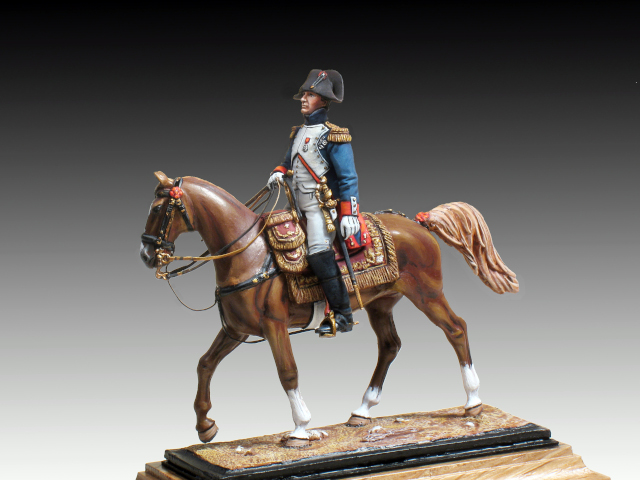
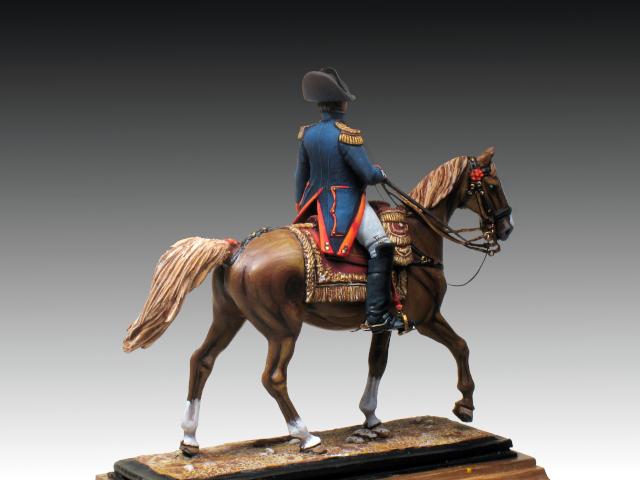
The figure depicts Napoleon reviewing the troops in the Tuileries Gardens. The emperor is wearing the uniform of a colonel of the Imperial Guard’s Foot Grenadiers (a blue uniform with white trim and red cuffs), a uniform he always wore whilst in the palace, reserving the green uniform of a colonel of the Imperial Guard’s Mounted Hunters for travel and campaign. He wears the decorations and sash of the Legion of Honour and the Order of the Iron Crown, along with gold epaulettes, white French-style breeches and high boots. He wears Napoleon’s characteristic bicorne, black with a cockade in the national colours.
In his right hand he holds the riding crop so often used by the emperor, whilst on his left side, hanging from his belt, is his dagger. The horse is fitted with Napoleon’s parade saddle, a replica of which is kept at the Musée de l’Armée.
He is riding a palomino-coloured Spanish horse, a gift from King Charles IV of Spain.

Reviews
There are no reviews yet.