€68.00
Figure to assemble and paint
Ref.: 12 – PCA
Weight: 200 grs.
Material: White metal
Number of Pieces: 12
History:
Rqised in 1657 as the Colonel General Cavalry Regiment in honor of its owner, Marshal de Turenne, who had just been appointed Colonel General of Cavalry.
- 1791 – Renamed the 1st Cavalry Regiment.
- 1801 – Becomes the 1st Cavalry Regiment – Cuirassiers.
- 1803 – Becomes the 1st Cuirassier Regiment.
- 1814 – Becomes the King’s Cuirassiers after the restoration of the Monarchy.
- 1815 – Reverts to being the 1st Cuirassier Regiment for the Hundred Days.
- 1816 – Takes the name Queen’s Cuirassiers after the second Restoration.
- 1830 – Reverts to the 1st Cuirassier Regiment with the return of the Monarchy.
- 1919 – Disbanded.
- 1940 – Established in January under the same name as a tank regiment. Disbanded in August.
- 1943 – Re-established.
- 1999 – Merged with the 11th Cuirassier Regiment to form the 1st/11th Cuirassier Regiment, becoming the 1st Squadron of the new regiment.
- 2010 – The 1st/11th Cuirassier Regiment became the 4th Dragoon Regiment.
The 1st Cuirassier Regiment (1st RC) was a cavalry regiment of the French Army, formed during the Revolution from the Regiment of Cavalry of the Colonel General, a French cavalry regiment of the Ancien Régime, known as the 1st Cavalry Regiment before being renamed during the First Empire.
It participated in all the Napoleonic campaigns. Between 1806 and 1808, as part of the IV Reserve Corps, it distinguished itself at Austerlitz, Jena, Eylau, and Friedland. Its last major charge took place at Waterloo, while attached to the 1st Brigade of the 13th Division of the IV Cavalry Corps. It remained quartered from 1816 to 1830.
Between 1850 and 1870, the 1st Cuirassier Regiment did not participate in any battles. During this period, it was garrisoned in Lille (1852), Cambrai (1854), Lille again (1855), Arras (1856), Versailles (1857), Saint-Omer, Saint-Avold, Sarrebourg, Sarreguemines (1860), Haguenau, and Belfort (1867). In 1869, the regiment’s four squadrons assembled at Lunéville to be assigned to Girard’s Brigade of the 2nd Reserve Cavalry Division of General Bonnemains’ III Army Corps. On August 1, 1870, in the context of the Franco-Prussian War, the regiment left the Lunéville garrison to participate on August 6 in the Charge of Reichshoffen, where it lost approximately sixty men.
In 1873, it joined the 5th Cavalry Division, headquartered in Nancy. In 1876, the regiment was assigned to the 1st Cavalry Division. From May 1881, it joined the 2nd Cuirassier Brigade, part of the 2nd Cavalry Division, and was stationed in Melun and later in Lunéville.
From August 1914 to November 1918, the 1st Cuirassier Regiment was attached to the 2nd Cuirassier Brigade, which was part of the 1st Cavalry Division. It participated in World War II as a tank regiment.
From 1940, it was equipped with Hotchkiss H39 and Somua S35 tanks. From 1943, it was re-established and assigned to the 5th Armored Division, this time with American Sherman tanks. From the end of the war until its merger in 1999 with the 11th Regiment, it was garrisoned in Germany, except for the period 1957–1960 when it was deployed to Algeria. Established in April 1957 in the Dahra massif, its headquarters were located in Cassaigne (present-day Sidi Ali). He returned to Germany on December 12, 1961, and settled in Saint-Wendel, in the Saarland region, where he remained until its merger in 1999.
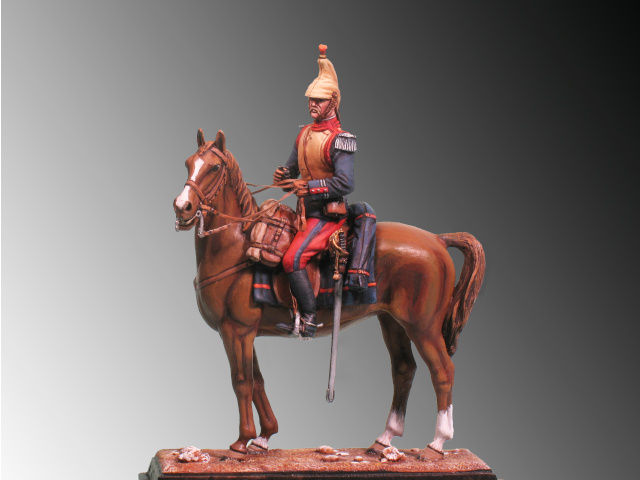
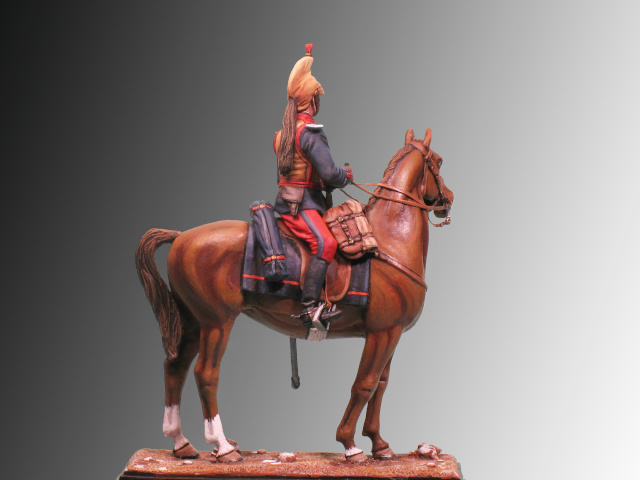
The figure shows the uniform he wore when mobilized in August 1914. As can be seen, it differed very little from the uniform of his grandfathers during the Napoleonic era. The troops carried the Berthier Model 1890 carbine. The saber corresponds to the model reformed in 1854. Like all French cavalry sabers, it was a superb weapon, five centimeters shorter than its predecessor. He also carries the Lebel Model 1892 revolver, which replaced the MAS revolver of 1873. It was the standard sidearm for officers of the French Army during the First World War.
Given the shine of both the helmet and the breastplate, personnel were provided with khaki cloth helmet covers that allowed them to keep the horsehair plume typical of these units out of sight. As for the breastplates, given the danger posed by their meticulous polishing, the troops themselves opted to stop polishing them and, in some cases, even went so far as to cover them with burlap or padded vests.