
You must be logged in to post a review.
€89.00
Figure to assemble and paint
Ref.: 16 – GE
Weight: 195 grs.
Material: White metal
Number of Pieces: 11
History:
José Marina Vega – 1909
General José Marina Vega was the son of Mr José Marina, a military officer, and Mrs Dolores Vega. He was born in Figueras (Girona) on 13 April 1848, and at the age of six he moved to the island of Luzon, in the Philippines, where he spent his childhood.
Much of his military career was spent overseas, in the Philippines, Cuba and Puerto Rico. Since then, a mere enumeration of Marina’s military career would yield an almost endless list; as a commander and officer, he held twenty-eight posts in the Philippines, Cuba and the Iberian Peninsula, and as a general he held fourteen military posts, four political posts (civil governor of Barcelona, undersecretary and twice Minister of War) and one political-military post (high commissioner).
In 1872 he returned to the Iberian Peninsula, spending the four years of the Carlist War in the north. During these operations, in addition to numerous decorations, he received three promotions in rank (captain, major and lieutenant-colonel) and two in post (captain and major). It should be noted that being awarded a rank meant being able to exercise that rank in operations and other duties, whilst retaining the same position in the seniority list as in the previous post. The advantage lay in the fact that, upon promotion through the seniority list, one received seniority dating from the date the rank was awarded.
Once the Carlist War was over, Marina served in various posts in the Philippines, Puerto Rico and Cuba. On 1 January 1899, he refused to allow the Spanish flag to be lowered in Matanzas (Cuba); it is said that he lowered it himself and took it away, keeping that Spanish flag for the rest of his life.
He also served as a teacher and headmaster of the Military Academy, Military Governor of Barcelona, Civil Governor of Biscay and Valencia, and Under-Secretary of the Ministry of War. In his private life, he married Concepción Aguirre in 1880, the daughter of the famous Brigadier Aguirre Echagüe, with whom he had six children.
However, it was in Melilla that he left a profound mark, when, on 9 July 1909, an attack took place resulting in the deaths of several railway workers – an event that sparked the ‘Tragic Week of Barcelona’. The general received orders to defend the city; he had no choice but to move beyond its boundaries and establish defences in the foothills of the Gurugú massif at four main positions: Sidi Hamed-el Hach, where he set up his headquarters, Sidi Musa, Sidi Ali and El Atalayón.
José Marina resigned from his post as Captain General of Melilla, citing health issues—though it appears he was, in fact, deeply aggrieved by the criticism leveled against his performance the previous year by certain conservative parliamentarians; he also bore the heavy burden of the many deaths that had occurred under his command on African soil. His resignation was accepted on August 25, 1910.
In November 1911, he was appointed Captain-General of the First Military Region. In 1913, he was appointed High Commissioner of Spain in Morocco, immediately following the signing of the agreement with France on the partition of Morocco, which led to the establishment of the Spanish Protectorate in Morocco. In 1915, he stepped down from the post of High Commissioner.
He was awarded the Grand Cross with Laurels of San Fernando in July 1915. In March 1918, he was appointed Minister of War, a post he held until the end of the year. In 1919, he became a life senator. He died at the age of 78 on 30 January 1926.
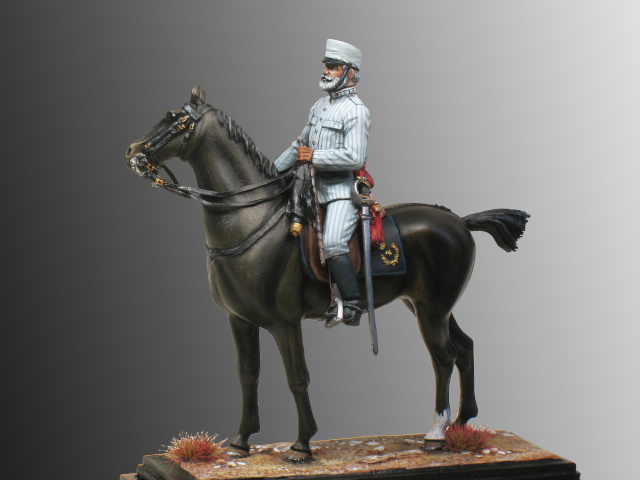
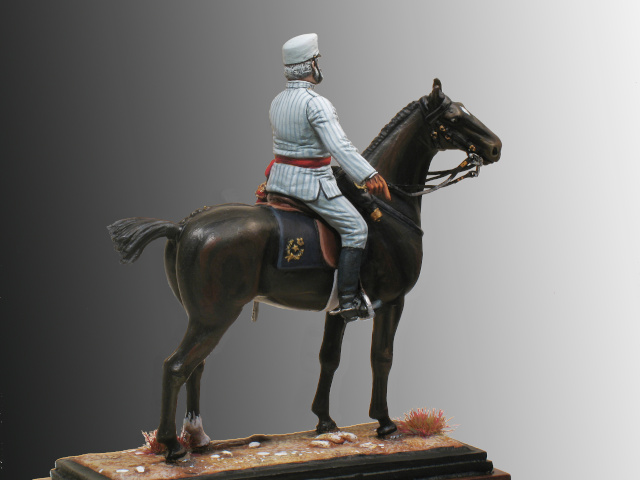
The figure is set during the Rif campaign. He is seen reviewing the troops as Commander-in-Chief of the Army of Operations in the Rif. He wears the striped uniform characteristic of our troops in Africa. The white scabbard on his field uniform is visible. He carries the regulation saber. He wears the general’s sash with the tassels corresponding to his rank of Major General. In many photographs from that period, he can be seen with the distinctive baton of command that General Marina carried during his time in Africa.



Reviews
There are no reviews yet.