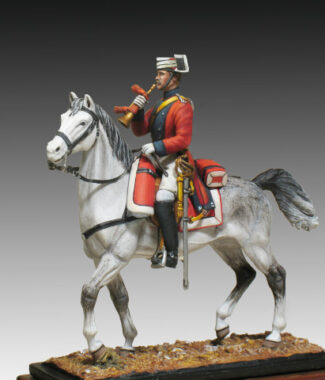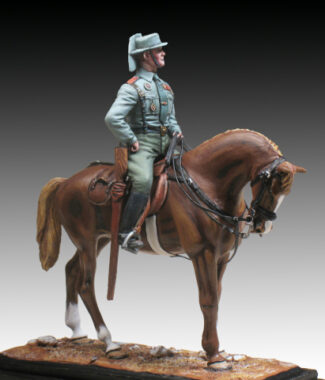
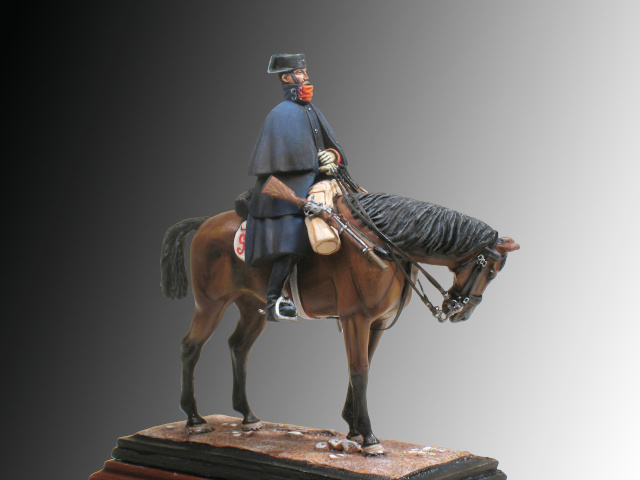
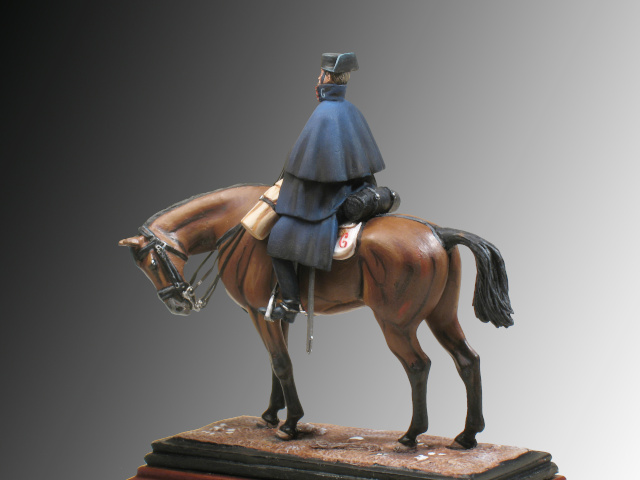
€68.00
Figure to assemble and paint
Ref.: 02 – GCC
Weight: 200 grs.
Material: White metal
Number of Pieces: 11
History:
The General Instruction on the Uniform of the Civil Guard, dated 28 March 1866, remained in force until 1886.
Whilst Lieutenant General Tomás García de Cervino y López de Sigüenza was Director of the Corps, during his second term of office, the first UNIFORM REGULATIONS issued by the Institute were approved by Order of 15 November. These regulations not only incorporated and perpetuated previous provisions but also established standards regarding measurements, cuts, colours and styles, and introduced new garments in keeping with the fashion of the time. The promulgation of that handbook undoubtedly represented a significant step forward in terms of the Corps’ uniformity.
However, on 15 January 1873, following the establishment of the new government of the First Republic, the uniform underwent another significant change, with a number of items being removed. With all these changes in place, the Civil Guard took part in the Carlist campaign in the north. Subsequently, in March 1875, these regulations were repealed, and the previous uniforms were reinstated.
As for the attire of the cavalry guards, the hat, cap, tunic, frock coat, gaiters, trousers, bow tie, shirt, blue woollen jacket and boots were identical to those of the Corps’ infantry.
The boot cuff was made of white knit fabric. The riding boots were made of oiled calfskin; once put on, the boot had to be gathered at the leg. The iron spurs, of the so-called ‘pigeon-neck’ type, were used on both riding boots and ankle boots. The latter, for cavalry use, had the corresponding tab to secure the spur. The gloves were made of yellow suede for mounted duty, and of cotton for use within towns.
The cape, like the tunic, was made of dark blue cloth with flaps, two inside pockets on the front, a high collar fastened with three hooks, and a red waistband with a small button at each end; it had a 47-centimetre-long cape, five large buttons to fasten the body and five small ones at the back opening. A distinctive feature was the way the Winchester Model 1873 carbine was carried, with a cover to protect the barrel and a strap securing it to the front pommel of the saddle. It was declared standard issue for the Corps’ cavalry in 1893. It is considered the first repeating long gun in the Civil Guard and was used in Spain until the first third of the 20th century. Beneath the cape, one can see the sabre that was worn hanging from the jacket belt.
The English-style saddle had entered service in 1893. Black girths (breastplate, crupper and bridle headpiece, whilst the stirrup leathers were hazelnut-coloured). Black leather, elliptical-shaped saddle bag. The day cover for the troop’s cape was made of earth-coloured canvas. The troop’s saddle bag was made of earth-coloured canvas and was semi-circular in shape, slightly longer than it was wide, with a flap for fastening; on the outer sides, the initials G.C. were embroidered in red with the royal crown above them.
This uniform remained virtually unchanged until 1934.