
€68.00
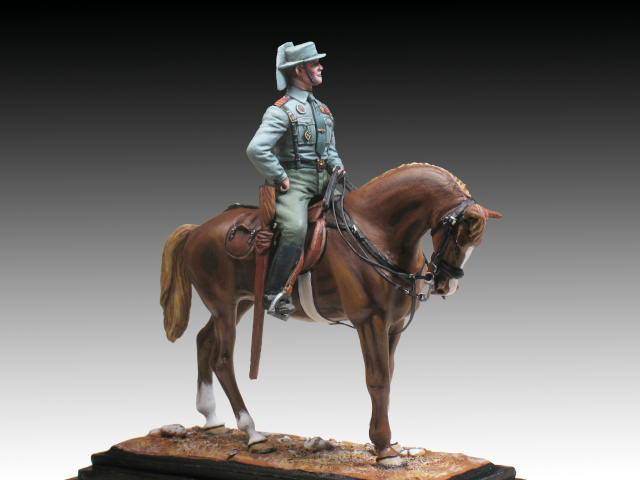
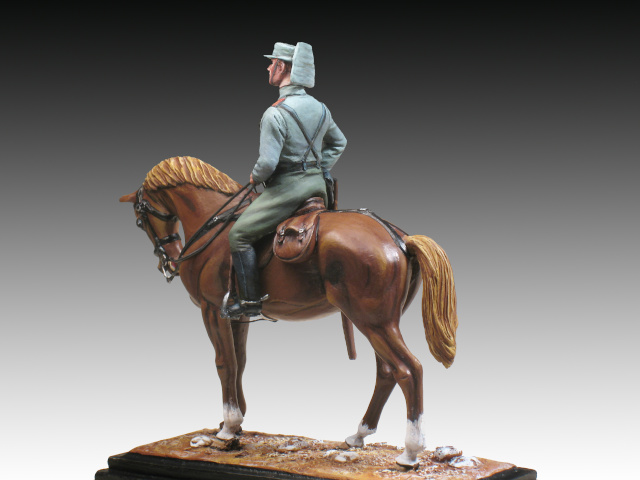
Figure to assemble and paint
Ref.: 1 – GCC
Weight: 250 grs.
Material: White metal
Number of Pieces: 16
History:
On 28 February 1975, a comprehensive provision on uniformity for the Civil Guard was issued, which, on the one hand, brought together what had been established since 1943 and, on the other, introduced a series of reforms whereby certain items of clothing were eliminated, others were modified, and some new ones were introduced.
The items of clothing that were eliminated were:
– The yellow bandolier
– The elastic patent leather boots
– The spats
– The cuffs of the open dress jackets for general officers
– The dress epaulettes on the green uniform
– The belt loops on the straight trousers
– The gold piping on the cuffs of the dress jackets
The following items were modified:
– Everyday epaulettes
– Cuffs and epaulettes on the blue uniform.
The garments that were introduced were those related to the uniform for social events: white jacket, cape, etc.
As a result of the changes established, each of the uniforms to be worn by the Corps personnel was numbered and named in the aforementioned provision. These uniforms were as follows:
– Uniform No. 1 – Full dress in formation
– Uniform No. 2 – Full dress on parade
– Uniform No. 3 – Half dress on parade
– Uniform No. 3 bis – For special events
– Uniform No. 4 – Daily in formation
– Uniform No. 5 – Daily parade
– Uniform No. 6 – On duty: A (urban) and B (rural)
– Uniform No. 7 – Full dress for social events
– Uniform No. 8 – Half dress for social events
– Uniform No. 9 – Daily for social events
– Uniform no. 10. – Specialities
The Civil Guard is the only branch of our army that still uses horses for active service. In addition to the Squadron of the First Mobile Command (stationed in Valdemoro, Madrid), some Commands have mounted sections to provide useful long-distance patrol services.
The figure’s uniform is characterised by breeches and riding boots (tubes over elastic boots for the troops) and is also distinguished by the emblem worn on the right pocket. In winter, a cape is worn.
Hanging from the saddle is a 1943 Mauser rifle, slightly shorter than the 1916 model, already chambered for the new 7.62 (NATO) cartridge adopted by the Spanish army. They remained in service until they were gradually replaced by the CETME assault rifle. As a sidearm, he carries the Star Model BM 9mm Parabellum pistol, adopted as standard issue in 1975.