
You must be logged in to post a review.
€68.00
Figure to assemble and paint
Ref.: 11 – TC
Weight: 250 grs.
Material: White metal
Number of Pieces: 14
History:
In September 1911, following the outbreak of the Italo-Turkish War between Italy and the Ottoman Empire, Cyrenaica – the eastern region of present-day Libya – was occupied by the Italians. At the end of the war, in October 1912, Turkey ceded Cyrenaica and Tripoli (renamed Tripolitania – the western region of Libya) to Italy. Italy, however, was at war with the Libyan rebels.
The reconquest of Cyrenaica refers to the final part of the reconquest of Libya, and specifically to that conflict in the colony between Italian military forces and the Libyan resistance that began in 1928, continued with a crescendo of Italian military actions against the resistance and ended in 1931 with the defeat of the rebel resistance and the capture and hanging of the indigenous resistance leader Omar al-Mukhtar. The pacification was carried out by the Italians with extensive recourse to massacres and atrocities and also involved mass murder of Cyrenaica’s indigenous population: a quarter of Cyrenaica’s population of 225,000 died during the conflict. Italy committed numerous heinous war crimes during the conflict, including the use of illegal chemical weapons, the refusal to take prisoners of war by executing surrendered combatants, and mass executions of civilians. The Italian authorities carried out ethnic cleansing by forcibly expelling 100,000 Cyrenaica Arabs (half the population of Cyrenaica) from their settlements, which were allocated to Italian settlers
In 1934, Italy united the territories of Cyrenaica and Tripolitania into the Italian colony of Libya.
Zaptié was the designation given to the Italian carabinieri units and the various gendarmerie locally created in the Italian colonies of Tripolitania, Cyrenaica, Eritrea and Somaliland between 1889 and 1943.
The word ‘zaptié’ is derived from the Turkish zaptiye; a term that was used to refer both to the gendarmerie of the Ottoman Empire before 1923 and to Turkish personnel recruited for the Cyprus Military Police during the period of British rule on the island. The Turkish word zaptiye is derived from the Arabic word dhaabe’ meaning officer.
The Italian colonial governments in the territories listed above modelled the various Zaptié police forces on Italy’s own carabinieri. The first of these units was raised in Eritrea in 1882, from existing companies of basci bazuks (irregular troops).
In Tripolitania and Cyrenaica, zaptiés were generally used to patrol rural areas in coastal regions, while mounted police or spahis operated in the southern desert regions, along with camel-mounted meharists. Civilian police were employed in the city of Tripoli. The original Libyan Zaptié were recruited from the indigenous gendarmerie of the same name, which had served under Turkish rule before 1910.
In Italian Somaliland, the Zaptiés provided a ceremonial escort to the Italian viceroy (governor) as well as to the territorial police. There were about a thousand such paramilitary police in 1922, when Benito Mussolini took control of the Italian government and initiated a policy of ‘pacification’ and assimilation of the Italian colonies.
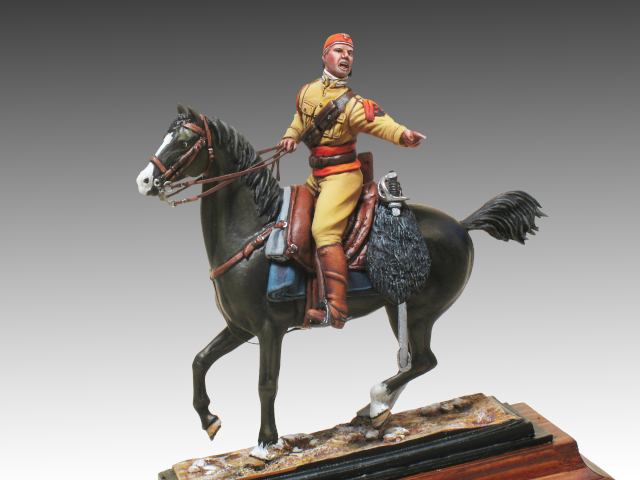
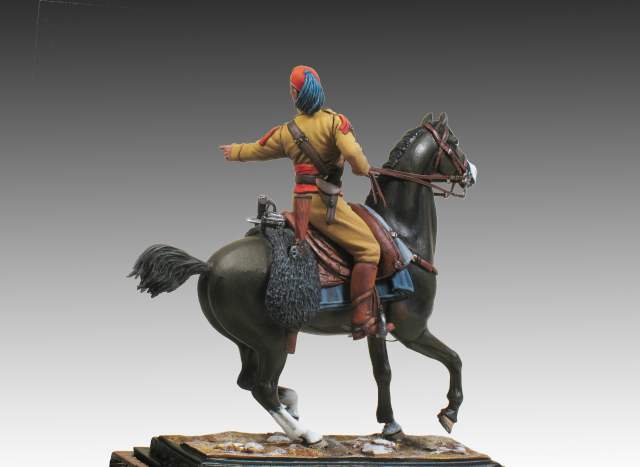
Our non-commissioned officer bulucbasci, a Turkish word meaning ‘company commander,’ was a military rank in the Italian colonial troops, equivalent to the rank of sergeant in the Royal Italian Army. The rank was lower than that of sciumbasci or ordinary marshal, which is the second rank of non-commissioned officers in the Italian Army, and higher than that of muntaz, corporal.
Wears the traditional khaki uniform with a shirt decorated at the collar with a red-covered sardine, characteristic of the Carabinieri. He wears the leather gaiters for mounted corps provided for the zaptiè on mounted service. The equipment is the standard equipment for non-commissioned officers of mounted Carabinieri units with the shoulder strap mod. 1902 with two pockets for pistol cartridges and the cavalry belt, both in natural leather. The armament includes the cavalry sabre mod. 1879/87 with a belt and pistol model 1874. These squadrons were equipped with the Manlincher Carcano Model 91 cavalry carbine, housed in its holster and carried in one of the horse’s leather saddlebags.
This saddle is the regulation Italian army saddle of the Maremma model. This saddle came from the large geographical region of the same name, which includes parts of Tuscany and Lazio.

Reviews
There are no reviews yet.