
You must be logged in to post a review.
€68.00
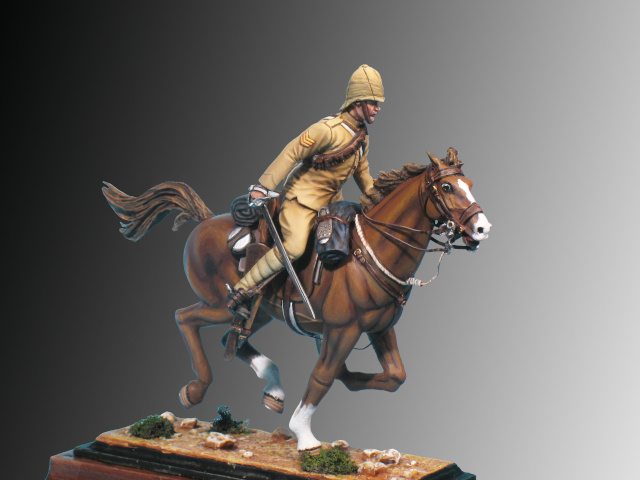
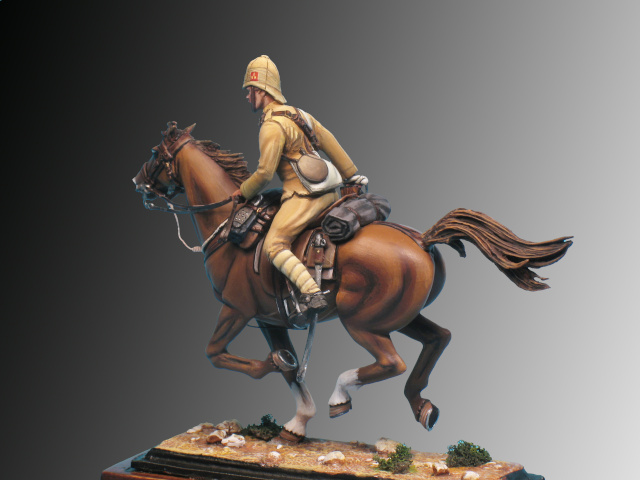
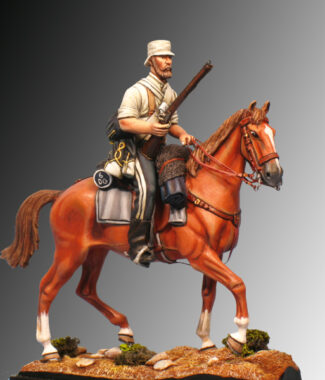
Figure to assemble and paint
Ref.: 11 – CRV
Weight: 75 grs.
Material: Resin.
Number of Pieces: 18
History:
The 5th (Princess Charlotte of Wales’s) Regiment of Dragoons Guards was a cavalry regiment of the British Army, formally raised in January 1686 as the Earl of Shrewsbury’s Regiment of Cavalry.
Raised in 1686 as Named after Colonel Earl of Shrewsbury’s Horse.
1746 – 2nd Irish Horse
1788 – 5th Regiment of Dragoon Guards
1804 – 5th (the Princess Charlotte of Wales’s) Regiment of Dragoon Guards
1823 – 5th (Princess Charlotte of Wales’s) Dragoon Guards
1921 – 5th Dragoon Guards (Princess Charlotte of Wales’s)
In 1922, the regiment amalgqmqted with the 6th Dragoon Regiment (Inniskilling) to form the 5th/6th Dragoon Regiment. Its history and traditions continue today in the Royal Dragoon Guards, an armoured cavalry unit of the British Army.
On 1 January 1686, several independent cavalry troops raised in response to the Monmouth Rebellion of 1685 were combined to form the Earl of Shrewsbury’s Cavalry Regiment. It was initially commanded by Lord Shrewsbury, with John Darcy, Lord Conyers, as his lieutenant colonel.
After the Glorious Revolution of 1688, the regiment served in the Williamite War in Ireland, including fighting in the Battle of the Boyne and the First Siege of Limerick. When the Nine Years’ War ended in 1697, the regiment escaped disbandment by becoming part of the Irish military establishment, where it remained until the creation of the United Kingdom in 1801.
During the War of the Spanish Succession, the unit was commanded by William Cadogan, a close associate of the Duke of Marlborough. It took part in many of Marlborough’s battles and sieges, including Blenheim, Ramillies and Malplaquet. After the Peace of Utrecht in 1713, it resumed its garrison duties in Ireland, where it spent most of the next 80 years.
Renamed the 2nd Irish Cavalry Regiment in 1746, it then became the 5th Dragoon Guards Regiment in 1788. When the French Revolutionary Wars broke out in 1793, it was sent to Flanders where it fought in the Battle of Beaumont in April 1794. The unit returned to Ireland and helped suppress the Irish Rebellion of 1798, including the battles of Arklow, Vinegar Hill and Ballinamuck. In 1804, it was renamed the 5th Regiment of Dragoon Guards (Princess Charlotte of Wales) in honour of Princess Charlotte, later simplified to the 5th Regiment of Dragoon Guards (Princess Charlotte of Wales).
Deployed to Spain in 1810, it formed part of John Le Marchant’s brigade during the Peninsular campaign. The Battle of Salamanca in July 1812 is considered one of Wellington’s greatest victories and Le Marchant’s attack the “most destructive charge ever made by a cavalry brigade in the entire Napoleonic period”. The regiment celebrated “Salamanca Day” until its disbandment in 1922; the tradition continues among several units of the modern British Army.
Redesigned as heavy cavalry, it was sent to the Crimean War in 1853 and fought in the Battle of Balaclava in October 1854. The Charge of the Heavy Brigade was a famous action, but casualties were relatively light; the Brigade as a whole lost 92 killed and wounded in total, 15 of whom were from the 5th Guards Dragoons. A small detachment joined the Nile Expedition in 1885, but its next serious action was during the Second Boer War of 1899-1902, when it fought in the battles of Elandslaagte and Ladysmith. He remained in service in various roles once the regiment was transferred to the south-east of the Transvaal.
During the First World War, it was part of the British Expeditionary Force that landed in France in August 1914. Renamed the 5th Guards Dragoons (Princess Charlotte of Wales) in 1921, it merged with the 6th Dragoon Regiment (Inniskilling) the following year to form the 5th/6th Dragoon Regiment.
The front line of the dragoon regiment carried lances from 1892, along with the Lee-Metford carbine and the 1890 sword in a scabbard on the saddle. The figure is equipped with an ammunition bandolier used by cavalry at that time. Holding ten rounds of ammunition, five such pockets were looped on a belt and worn over the left shoulder. Backpack, canteen and belt with sword straps fastened together. Hussars wore the belt under their jackets.
Reviews
There are no reviews yet.